

A small Orlando shop should not run the till, orders, and client files on someone’s personal phone. A company system is the opposite: Linux on the office desk, company Android on the floor if you need handhelds, and a screen staff can actually use. Routine steps can be handled by agents. People review the rest.
That build is quoted after we see what you run today.
Company software lives on machines you can point at. Personal photos stay off them. Client files stay on them.
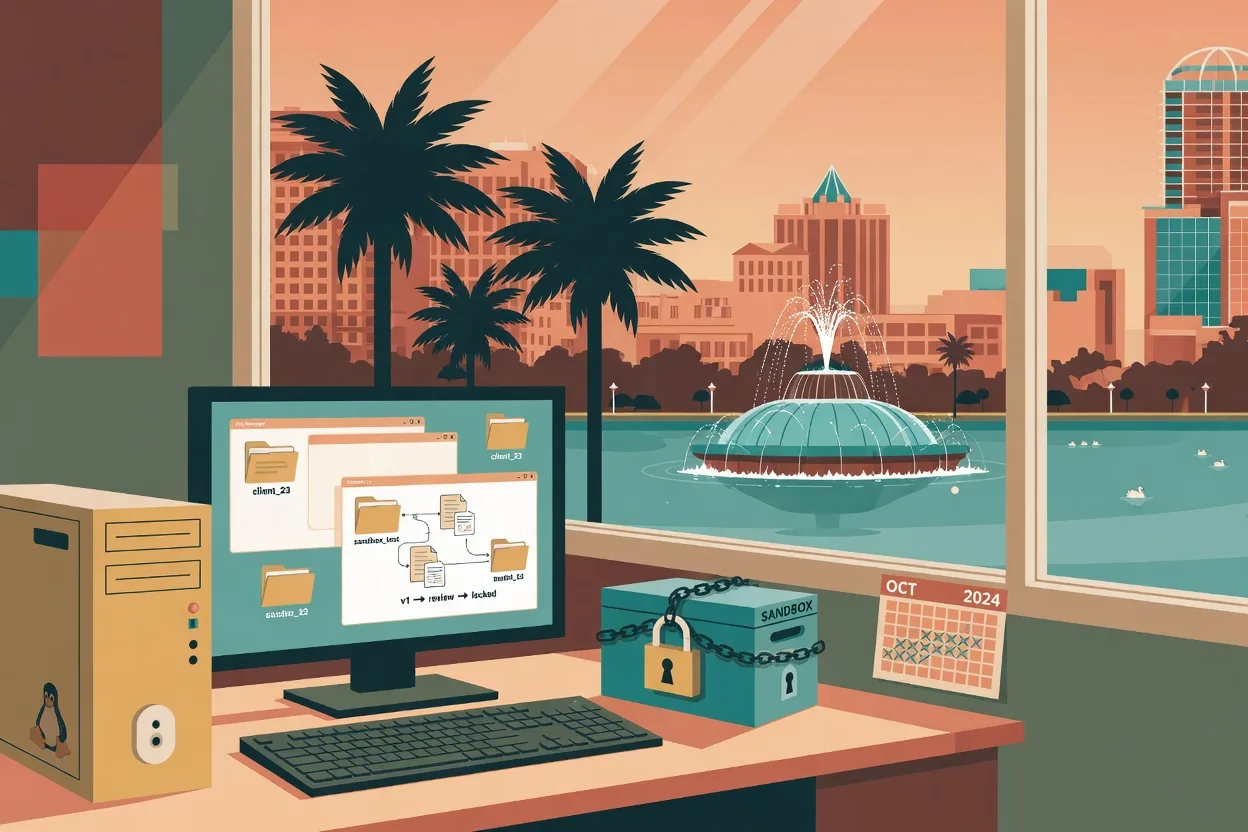
What “local” means here
Customized local software is not “everything in the cloud with a logo.” It is software on machines you can see: a Linux workstation in the office, a company Android in the van, a container on a server you already pay to keep patched.
- Linux — the company computer. Open-source tools and your own apps, without a new monthly seat for every job. Custom Linux systems.
- Company Android — a handheld with only the apps and data you approve. Personal mail and photos stay off it. Company Android.
- Containers — a way to keep each service in its own box so an update does not take the whole shop down. Containers.
The suite page is custom business systems.
Sandbox
A wall between company work and personal data. Each app gets only the files and network you grant. That is how a five-person shop keeps the till off someone’s camera roll.
What staff actually use
A visual screen with an auditable trail for the jobs that make rent:
- Intake — a request lands as a record, not a text thread
- Payments — the payment tool you already use, with a trail
- Client relations — who you talked to, what they asked
- Orders — queued so a person can check before anything ships or charges
- Documentation — drafts an agent starts, people finish
- Creative / branding — original content on the same desk, not a side app that owns the files
Agents do not mean unsupervised. Same idea as phone receptionists / voice agents: capture and scheduling you can customize, transcriptions and logs, a follow-up email or a draft when you want one. Money, orders, and client documents wait for a person.
Why a small shop can do this now
Ten years ago this needed a staffed IT group. Open platforms, containers, and agentic tools changed that — not the need for notes and backups. You still need someone who can restore. You do not need a floor of specialists to own intake-through-docs on a company machine.
The companion piece is Linux as an open platform versus subscription stacks. This page is the shop-floor version.
A short systems check
- Which jobs must stay on a company device (till, orders, client files)?
- Which jobs can stay on a personal phone? (They should be few.)
- Do you need a Linux desk, a company Android, or both first?
- Which agent jobs need a person to look before they send?
Want that conversation for a Central Florida shop? Contact Orlando Web & IT. Bring what you run today.